Showing posts with label Human Rights. Show all posts

Tuesday, May 14, 2013

Outsourcing at irrational scale to serve greedy or desperate employers and investors -- emptying local employment, middle class hardest hit

It has been a rough ride for middle class Australians in the last couple of years.  I'm not even talking about ever rising prices of electricity, food, housing, transport, medical, insurance and other basic necessities. It is more challenging to hold a job with decent income to support your family for those with more responsibilities than self sustenance.

No longer does a good education and specialized skill guarantee you job security till pass middle age.

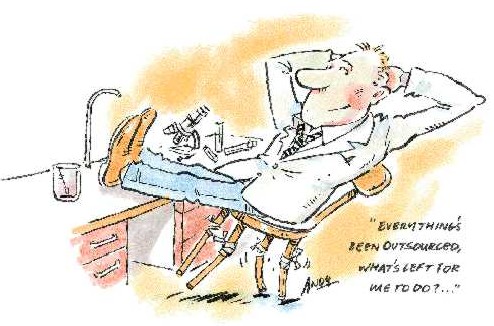
Starting with manufacturing, we thought that higher value added jobs could be retained locally. Not any more. IT (information technology), accounting services, and now legal services can be outsourced on a massive scale. Employers have no qualms about taking the sledge hammer to export jobs, with little consideration to coordination, sensitivity of information and understanding of local environment.

Labour intensive  -- Low cost component -- Assembly / Semi-skilled processes -- Design -- Innovation

Every industry and sector has no qualms and almost ridiculously competing to outsource each other -  textile/garment, light industry, banks, construction, telco, airlines, financial services, etc.  Eventually, when labour of developing nations become more highly educated, skilled and creative, which they will catch up with us sooner than later, even designing and innovative jobs can be shipped overseas.  Only few food and personal services and care could not be outsourced.

Just because everyone is doing it does not make it alright.


Despite the political soundbites in favour of protecting local jobs, there is little the federal or state government could do to interfere with private business decisions.

http://www.change.org/en-AU/petitions/prime-minister-julia-gillard-stop-outsourcing-australian-jobs-2

Hypocritically, even local governments contemplate outsourcing jobs.

http://www.brisbanetimes.com.au/it-pro/government-it/councils-job-outsourcing-plans-breach-eba-union-20130107-2ccy0.html


On the surface, it makes good economic sense, from the employers' point of view. Capitalist economic theories teach us to the benefits of division of labour and comparative advantage. It's good for business by lowering to cost, doing what we are best at, and maximisig profits. Welcome to the real world of globalisation and competition. It does not take into consideration social stability and compromise quality of services.

No matter how hard you have worked, giving up your health and best part of your life and time, and no matter how good you may be at your job, and contributed to your company's growth and profits, employers can be ruthless and have skilled efficient workers who do not fit into their short term purely cost (not even profit) driven gameplan to cut jobs. The air of distrust and low morale pervades many workplaces of today. It is no wonder more people are falling sick, especially work anxiety.

If jobs can be neatly compartmentalized, could be performed efficiently and cheaply by skilled workers in India, China, Indonesia and Vietnam. We have nothing against individual workers overseas as they too need to make a living and probably work under less enviable terms and conditions.

The real culprits who should be made to answer the questions are the heartless creatures who decide on making every opportunity to outsource, regardless of its suitability. Mindless restructuring and outsourcing has created a vacuum. A small percentage of former staff laid off by companies have been re-employed as contract staff at higher salaries to fill the gaps that foreign labour are unable to accomplish. There you have a dumb decision immediately exposed. There will come a time, and it should be sooner, that senior management could be outsourced too, for making silly mistakes.

Adjustments are invariably difficult and take a long time to achieve positive results, if they in fact do so.  Our education reforms have met with funding shortage and strong resistance from educationists, parents and politicians. We would be hard pressed to develop relevant skills to keep jobs locally.

Depreciation of the unrealistically high Aussie dollar is inevitable. Australian goods and services have become uncompetitive. Life has been good to us in the recent past thanks to the mining boom. Australian travellers have been able to stretch the value of their dollar and enjoy during good times.

However, with the slowdown in exports, rising unemployment, high living costs and mortgage (despite rate decrease) becomes more painful.

To be employed and have a gainful employment for a large part of our lives is a basic human right. It is useless to talk about esoteric theories and ideals when we can't even carry on with decency and dignity.

This is going to be a cold, harsh and long winter.


Tuesday, July 5, 2011

NSW Burqua Laws : covers security, religious sensitivity yet politically correct

Though NSW is credited for introducing clearer burqua laws, the legislation is long overdue. A controversial and sensitive topic, a prudent measure has finally cleared the air and tensions that constrained law enforcers and reassured the public.

NSW government's decision to force people, including Muslim women, to remove head coverings and helmet when asked by police is welcomed by many quarters, with the exception of some individual liberty and human rightis groups.

Quote : It follows the case of a Sydney woman who was acquitted of making a false accusation against a police officer because the judge ruled there was no way to confirm it was actually the woman due to the veil covering her face.


Unlike the intolerance and blanket rules agitated by conservative European politicians to ban religious cover, the NSW government has shown an objective and generic application of the laws that balances both ends of the spectrum. Politicians who play on emotions and whip up a frenzy are unlikely to go far and treading on a tight rope. NSW has got it right this instance.


Quote : Premier Barry O'Farrell has emphasised the change is not aimed at any specific religion or group, though he hopes it will prevent a repeat of Ms Matthews' case.


Even the Islamic Council is agreeable that safety and security issues should prevail in certain situations when the identity of the person who committed a crime or traffic offence must be verified against the ID photo.

Quote : The chairman of the state's Islamic Council, Khaled Sukkarieh, says a Muslim woman can reveal her face to a man for identification purposes.

"Islamically, for all Australians, irrespective of ethnicity or faith, shall respect and abide by the constitutional law of Australia. If this is handled in a sensible and a sensitive manner, there should be no issues whatsoever. ," Mr Sukkarieh said.


http://www.abc.net.au/news/stories/2011/07/05/3261038.htm

Some Arabs in progressive Jordan in fact see merits in discarding the traditional garbs that cover the face and body completely by women wearing the burqa and niqab especially when it constituted a security threat.

http://oneworldtalk.freeforums.org/abused-for-crime-the-veil-of-secrecy-t3276.html

NSW's unprecedented and no drama laws has prompted the West Australian government to act. Now that's something the First State could be proud about.

http://www.perthnow.com.au/news/western-australia/wa-to-consider-nsw-burqa-laws/story-e6frg13u-1226088006380

Sunday, January 16, 2011

Tunisian Revolution - what next? power vacuum does not bode well for secular democracy

Now that the autocrat Zine Al Abidine Ben Ali has been overthrown fled the country, is there cause for celebration?

Whether the Tunisian Revolution result in better or worse for the people depends on who are the players that fill the power vacuum. There appears to be no credible political alternative.

Surrounded Islamic fundamentalists and the festering instability threatening other "autocratic" modern secular governments in Islamic states, the "jasmine revolution" does not seem to bode well for secular democracy.

Iran, Iraq, ... we've seen the mayhem that follows a revolution.

So world liberals - don't hold your breath.

Quote : "

Similarities between Iranian and Tunisian revolts cannot be ignored

The Tunisian revolt, which began four weeks ago because of growing unemployment, food prices and corruption, quickly snowballed to embody the population's accumulated grievances against Ben Ali's iron-fist rule during the past 23 years.

He imposed his secular rule largely through a repressive security apparatus and good relations with France, the European Union and the United States, which backed him for maintaining political stability and promoting socio-economic development. In the process, he stifled the opposition, and personalised power and politics, with grievous human rights violations.

The circumstances of Ben Ali's overthrow are reminiscent of those of the US-backed shah of Iran, who was forced by a mass revolution to leave the country 31 years ago, also in mid-January. Just as the shah was declined asylum by his main patron, the US - ending up in Egypt where he died of cancer in July 1981 - Ben Ali has experienced a similar predicament.

After France refused him asylum on Friday, Saudi Arabia came to his rescue. Like the shah, he has left a country in a mess, with no united democratic alternative to take over.

The Speaker of the Parliament, Fouad Mebazaa, has taken over as interim president. He has asked Ben Ali's veteran Prime Minister, Mohamed Ghannouchi, to form a government of national unity until a president is elected within 60 days.

But this may not prove enough - just as the shah's installation of the reformist prime minister Shapour Bakhtyar in the 11th hour could not contain the flood of public discontent.

In the case of Iran, democratic reformers responsible for spearheading the revolution lost out to the shah's leading religious opponent, Ayatollah Khomeini, whose legacy of an Islamic government, with an anti-US posture, continues.

Tunisia is in the throes of a similar development, although the establishment of a theocracy does not seem to be an option, given the absence of a strong Islamist movement and lasting French secularist colonial influence in the country.

The US and the EU seem to have abandoned their goal of bringing democracy to the Arab world - which was once promoted fervently as a core issue in their Middle East policy - in favour of what is called security and development. Yet this is unlikely to halt people's quest for democratic reforms.

The Tunisian uprising may fail to achieve its goals but the struggle between the forces of authoritarianism and democracy will be a dominant factor in the Muslim Middle East in the years to come.

Amin Saikal is professor of political science and director of the centre for Arab and Islamic studies (the Middle East and central Asia) at the Australian National University. "

http://www.smh.com.au/opinion/politics/similarities-between-iranian-and-tunisian-revolts-cannot-be-ignored-20110116-19seo.html

http://www.smh.com.au/world/egyptians-believe-their-turn-is-coming-20110116-19smh.html

Wednesday, January 12, 2011

Mourning for Victims of Arizona Shooting - Gun Laws must take part of the blame

We know our prayers for U.S. Rep. Gabrielle Giffords have been answered when President Obama made the announcement in a passionate speech. However, many innocent victims in the vicinity of the targeted congresswoman have been mercilessly killed last weekend.

No matter what freedom fighters argue against the direct causal link between lax gun laws and random killings by mentally unstable persons, it cannot be denied that incidents of this nature will be cut down drastically with better regulation.

Don't we all know that the gun is a high calibre lethal weapon that could kill many in seconds? Why was Loughne even permitted to own a gun?

A number of Aussies have developed repungance for Howard's arrogance. But he must be praised for making innocent bystanders' lives a lot safer with the tightening gun laws in the aftermath of the Tasmania shooting.

America, we cry for you. Will the gun lobbyists, apologists and rightists will continue to win and rule America?

Saturday, December 11, 2010

Hypocrisy on human rights - walk the talk, why leaders shun Anwar Ibrahim?

Leaders like Anwar Ibrahim deserves our support. It is he who had been repeatedly and helplessly been maligned, framed, vilified and punished by an opaque and merciless government that has abused the judiciary and bureaucrcy to perpetuate its rule.

Kevin Rudd has shunned Anwar to appease the Malaysian government. Julia Gillard has too much problems in her hands to bother about Malaysian human rights issues.

http://www.theage.com.au/national/rudd-accused-of-appeasing-malaysia-20091204-kb2p.html?skin=text-only


http://www.radioaustralia.net.au/programguide/stories/200807/s2301012.htm


Recently, even Hilary Clinton avoided meeting Anwar during her visit to Malaysia.

"Clinton would speak to Anwar on the telephone but would not meet him face-to-face."

http://www.reuters.com/article/idUSTRE6A11NE20101102


Why do western leaders not live up to their ideals when it comes to Malaysia? This country has practised deliberate racial discrimination against the minority ethnicities (Chinese and Indians) of the worst kind and corrupt to the core. Nonetheless, western governments are apologetic and willing to gloss over such abhorent behaviour. Is it merely because Malaysia has a democratic form of government and deemed a moderate Islamic country that we must bend backwards to accommodate?

Despite reassurance and promises (mostly broken judging from past track record) by the Malaysian government, we know that Anwar Ibrahim will not be given a fair trial.

On the other hand, Kevin Rudd welcomed a Uighur fraudster with terrorist links, Rabiya Kadeer, with open arms. This incomprehensive code of practice, or to put it bluntly hypocrisy, requires explanation.

Have a good weekend if you can be at peace with your conscience.

Wednesday, May 12, 2010

Corporeal - real or imagined human and things

Definition of Corporeal according to the online dictionary :

1. of the nature of the physical body; bodily.
2. material; tangible: corporeal property.


In the legal context, we often distinguish between corporeal (flesh and blood) and the artificial entity of the company. The company has the benefit of protection undert the corporate veil. But ultimately, its directors (real people) are responsible if they mismange or engage in fraudulent activities. The rich and unconscionable bankers and industrialists may have to face the realities if the law catches up with them, some day.


In the cyber world, we encounter virtual peoples behind masks, if any skeletons in the closets, they will be discovered over a long time or never. The safety behind the monitor may guard against physical attacks but it does not stop cyber bullies from inflicting pain or declared altruistic philosophers who wish to change the world but injure others in the process. Take care.

Wednesday, November 18, 2009

Another form of school grounds bullying - racism still rears its ugly head among Anglo-Australian youths

In the past, I thought there wasn't much that my acquaintance who champions equality in a multicultural society at workplace and schools has to work on to improve current environment which appears satisfactory to me.

While I sometimes hear of and bear witness to subtle discrimination, this piece of news bolsters the case of those who continue to champion equality that racism is more pervasive and widespread than is recognised. This is another manifestation of human rights abuse slipping pass the net of protective laws and unmonitored school bullying.

MORE than two-thirds of young people are the victims of racism at school,
with first-generation migrant women in years 11 and 12 most at risk.

A national study has found that racism permeates Australian schools,
with 80 per cent of secondary students from non-Anglo backgrounds and 55 per
cent of students from Anglo backgrounds saying they had experienced racial
vilification.

Interviews conducted with 900 secondary school students across
Australia also found Anglo-Australian youths displayed consistent prejudice
towards other cultural groups, particularly towards darker-skinned students from
places such as Africa and India.

Students who attended a Catholic school were 1.7 times less likely to report experiences of racism than students going to government schools.
Racism made students feel angry, depressed, increased headaches, muscle tension and made them not want to go to school, the study found.


http://www.smh.com.au/national/schools-a-hotbed-of-racism-study-20091118-imk8.html


This is a sad state of affairs. Discrimination which stem from prejudices are much more intractable especially if such perceptions are partly cultivated at home, in society and through sublimal messages on TV or private jokes. More appalling is the fact that some officials (these youths who grow up and graduate to take up appointments of responsibilities to the public) too hold such prejudicial and judgement views on the basis of race. It may not easy to convince them to change the mindset but there are avenues for the persistent to seek redress.

Thursday, May 28, 2009

The Burmese Dilemma

Advice by neighbours, pain of continuous economic sanctions and protests by world citizens demanding the release of Aung San Suu Kyi have all fallen to deaf ears. Indeed, the Burmese military junta are more intransigent and recalcitrant than anyone can imagine.

Proponents of sanctions against the Burmese military junta are full of hypocrisy. It has long been proven that sanctions are ineffective. We've seen the futility when applied to Iran, South Africa and Iraq under Saddam. Despite official sanctions, many private businessmen including western middlemen and oil congolomerates have bypassed legal channels to carry on trade and investments in a supposedly isolated country. Sanctions would hit innocent Burmese people harder than the regime as the leaders could find alternative sources of income and financial services. It is impossible to cut off all ties with Burma nor is it advisable to do so. Australia which is a strong critic of the junta has trained Burmese police officers and hosts Burmese students who are children of the military leaders.
Engagement would have to continue no matter how loathsome it might be. Surely, we're not thinking of Bush's infamous : you're either with us or against us; or are some idealists tinkering with ideas of invading Burma to overthrow the junta?
Asian neighbours who know the Burmese culture well are aware they are a people with great pride regardless of their rank or social status. They would not bow down to pressure or public embarrassment. However, the patience of Burma's ASEAN members is wearing thin as the efficacy of engagement is proving impotent.
There are also limitations to how much Asian neighbours could pressure a sovereign country where the military still wields the reigns of power. Pragmatism often overrides humanitarian or moral considerations. What can we expect from some of these governments that aren't exemplary in their treatment of domestic opposition. Not just Asean, but energy hungry China, Japan, South Korea and France too. The impact of sanctions is more psychological.


One thing is certain is that the military junta's grasp of power is not sustainable in time to come. They have long defied the people's will shown in the results of the elections two decades ago. The junta has already lost their legitimacy to govern. Perhaps more sanctions would cause widespread starvation and hardship and turn the whole nation to revolt against the incompetent and corrupt regime.

An internal revolution from top down in Burma may be the most powerful and least disintegrative path to resolving the myriad of problems in Burma. Aung San Suu Kyi's has given new energy to the opposition groups in Burma and galvanise the people. Burma needs a people power revolution involving disgruntled subjects of the military junta to break the stalemate.

One way out of the quagmire would be for the military junta to relinquish economic management to the experts. They could well retire with the millions they have accumulated. A power-sharing agreement with Aung San Suu Kyi would be a face-saving way out for the military junta. At the same time, western governments and the diverse Burmese opposition should realize that a future government which totally excludes SLRC may not be workable and cause a breakdown in administration and lead to chaos. The contending forces should not let the opportunity slip pass. The junta should release Aung San Suu Kyi and help to bring about a national reconciliation government soon instead of bringing about their own downfall and bloodshed.