Showing posts with label employment. Show all posts

Tuesday, May 14, 2013

Outsourcing at irrational scale to serve greedy or desperate employers and investors -- emptying local employment, middle class hardest hit

It has been a rough ride for middle class Australians in the last couple of years.  I'm not even talking about ever rising prices of electricity, food, housing, transport, medical, insurance and other basic necessities. It is more challenging to hold a job with decent income to support your family for those with more responsibilities than self sustenance.

No longer does a good education and specialized skill guarantee you job security till pass middle age.

Starting with manufacturing, we thought that higher value added jobs could be retained locally. Not any more. IT (information technology), accounting services, and now legal services can be outsourced on a massive scale. Employers have no qualms about taking the sledge hammer to export jobs, with little consideration to coordination, sensitivity of information and understanding of local environment.

Labour intensive  -- Low cost component -- Assembly / Semi-skilled processes -- Design -- Innovation

Every industry and sector has no qualms and almost ridiculously competing to outsource each other -  textile/garment, light industry, banks, construction, telco, airlines, financial services, etc.  Eventually, when labour of developing nations become more highly educated, skilled and creative, which they will catch up with us sooner than later, even designing and innovative jobs can be shipped overseas.  Only few food and personal services and care could not be outsourced.

Just because everyone is doing it does not make it alright.
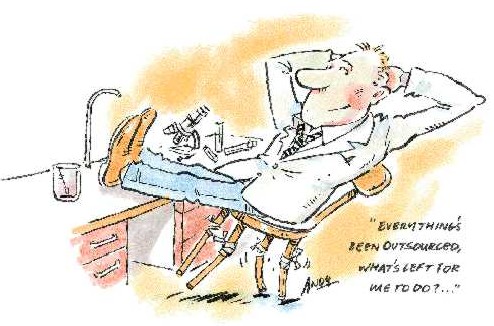


Despite the political soundbites in favour of protecting local jobs, there is little the federal or state government could do to interfere with private business decisions.

http://www.change.org/en-AU/petitions/prime-minister-julia-gillard-stop-outsourcing-australian-jobs-2

Hypocritically, even local governments contemplate outsourcing jobs.

http://www.brisbanetimes.com.au/it-pro/government-it/councils-job-outsourcing-plans-breach-eba-union-20130107-2ccy0.html


On the surface, it makes good economic sense, from the employers' point of view. Capitalist economic theories teach us to the benefits of division of labour and comparative advantage. It's good for business by lowering to cost, doing what we are best at, and maximisig profits. Welcome to the real world of globalisation and competition. It does not take into consideration social stability and compromise quality of services.

No matter how hard you have worked, giving up your health and best part of your life and time, and no matter how good you may be at your job, and contributed to your company's growth and profits, employers can be ruthless and have skilled efficient workers who do not fit into their short term purely cost (not even profit) driven gameplan to cut jobs. The air of distrust and low morale pervades many workplaces of today. It is no wonder more people are falling sick, especially work anxiety.

If jobs can be neatly compartmentalized, could be performed efficiently and cheaply by skilled workers in India, China, Indonesia and Vietnam. We have nothing against individual workers overseas as they too need to make a living and probably work under less enviable terms and conditions.

The real culprits who should be made to answer the questions are the heartless creatures who decide on making every opportunity to outsource, regardless of its suitability. Mindless restructuring and outsourcing has created a vacuum. A small percentage of former staff laid off by companies have been re-employed as contract staff at higher salaries to fill the gaps that foreign labour are unable to accomplish. There you have a dumb decision immediately exposed. There will come a time, and it should be sooner, that senior management could be outsourced too, for making silly mistakes.

Adjustments are invariably difficult and take a long time to achieve positive results, if they in fact do so.  Our education reforms have met with funding shortage and strong resistance from educationists, parents and politicians. We would be hard pressed to develop relevant skills to keep jobs locally.

Depreciation of the unrealistically high Aussie dollar is inevitable. Australian goods and services have become uncompetitive. Life has been good to us in the recent past thanks to the mining boom. Australian travellers have been able to stretch the value of their dollar and enjoy during good times.

However, with the slowdown in exports, rising unemployment, high living costs and mortgage (despite rate decrease) becomes more painful.

To be employed and have a gainful employment for a large part of our lives is a basic human right. It is useless to talk about esoteric theories and ideals when we can't even carry on with decency and dignity.

This is going to be a cold, harsh and long winter.


Tuesday, March 26, 2013

Changes to 457 Visa do not address fundamental problems of costs and productivity


457 visa changes  has all the appearance of pro-Australian, and few remaining lifeline for a lame government struggling to survive and praying for a slim victory in the coming elections.

It may help to temporarily placate local workers under the current difficult employment market but nothing more to boost the employment of locals. Besides, outsourcing renders import of skilled labour irrelevant.


As in other countries that had pandered to political pressures to give priority to locals seeking employment, artificial imposition of regulations would inevitably raise costs, limit options and unpopular with employers. It would be costly to fill higher skilled and niche vacancies. That could only spell trouble for the future, making Australia less competitive and short of skills.

Moreover, restriction on migration does not remove the prospect of Australians being made redundant and laid off through outsourcing to India, China and Indonesia. This trend has been ongoing for years unabated.

From call centres, IT to finance, employers are opting for cheaper foreign workers based overseas. With modern communications, there is less dependency on foreigners.

In reality, migrants by and large fill the gaps and taking over jobs that Australians shun or are unable to perform well. On the contrary, local born and bred are already enjoying a headstart and advantages as employers and recruiters do place a lot on the familiar sounding names and elementary education of applicants. Changes in 457 would indeed add more economic disadvantages to longstanding racial discrimination encountered by migrants. But whether it would be beneficial to Australians is doubtful.
.
The anti-foreign image of Australia will be more pronounced, as seen in earlier restrictions on employment for overseas students and graduates from Australian universities.

On the other hand, the government's shift to focus on a AUD 5 million investment visa has only started to kickoff. What impact would wealthy individuals seeking PR by investing in bonds and companies remains to be seen. It may not necessarily translate directly into more jobs for Australians if investors are playing safe with bonds and equity.


I have also heard from inside sources that some of these investors plan to import semi-processed or outsource some of the jobs overseas. All businesses, whether Australian, foreign or global, are very concerned with bottomline. The only way out is that Australians improve productivity, raise skills level, value add and offer products and services in high demand by the international market.

Protectionism by legislation would not help to solve fundamental and structural economic problems, not even in the short term.

Tuesday, October 9, 2012

Education too slow in responding to globalisation? Australia joins developed world in escalating outsourcing skilled labour overseas - retrenchments and net job creation

There is always a silver lining to negative news provided we vigorously address problems and plan for the future. 


Get used to it: sending jobs overseas is the way of the future
http://www.theage.com.au/national/get-used-to-it-sending-jobs-overseas-is-the-way-of-the-future-20121009-27bfh.html


Outsourcing has become a dirty word, threatening to cut more jobs of locals as companies seek lower cost of labour and production overseas. Rather than resisting and putting up artificial blocks, which won't work  anyway, we should go with the flow. Trade restrictions and doing nothing would only weigh us down and put us further behind the competitors.  

Having said the hard truth, outsourcing has gained a momentum of its own. The question is how to ride the storm and survive, if not thrive well. It is a challenge for the state to set the right direction and actually putting money where its mouth is and getting things done. Or else we are doomed. But looking at the way education and health budget is being slashed, procrastination and bickering over unimportant issues, the picture is more gloom than most politicians would like to believe. 

Retrenchments have splashed ruthlessly across corporate human resources lately and putting stress not only to those made redundant and their families, but co-workers who are fortunate enough not to be laid off, but left to do the extra jobs of the less fortunate who have been made redundant. The cull and more to come has left deep psychological scars on everyone and 

The well-connected and those armed with current, relevant and highly sought after skills have nothing to fear. Most are able to get another position in a related field or industry, often in the ex-employer's competitor firm. 

However, as the high performing developing countries with huge economies such as India and China move up the skills and value added ladder, the number and spectrum of jobs they are capable of performing as well as Australians increase as well. 
Quote : Occupations most at risk include those in information technology, administration, and jobs in finance and insurance and the professional, scientific and technical services sectors.
Indeed, I was taken aback when I realised that some IT and accounting staff processing our requests and orders are based overseas, contactable only by email (which they normally respond within minutes barring time zone difference), and whom we would unlikely to ever meet face-to-face. So it won't be surprising that even scientific trials that require long hours including weekend work, can be moved offshore. 

The bottomline for most companies is to get the job accomplished at the least possible cost. The issue is that Australian labour is getting too expensive (to catch up with rising cost of living and aspirations) taking into account extra hours and weekend penalty rates, leave allowance, labour protection laws, workers' compensation and taxes, and a long list of regulatory compliance requirements, which are still unheard of or de-emphasised in most developing countries. 

So, where does that leave the majority of the redundant workers? professional nursing or basic home carer for the old age and autistic kids. However, for a middle-ager making a career switch to a highly demanding (both physical strength and mental alertness), it is less than ideal for both the worker and the client.  

The young and fit would be better off become skilled tradesmen who are in perpetually short in supply and could pick and choose the type of work to do and when to turn up. This sounds familiar to most households who need small jobs done. Such jobs are difficult to outsource and safe as long as most Australians remain not so handy and technically incompetent. 

Australia's education score for high school and universities ranking remain dismally poor compared to US, UK and now Asian schools. Those who complain about competitiveness in local education system should take a look at the level of proficiency that counterparts offshore have attained in Math, Science and languages. The local curriculum is slow in adapting well to current needs and keep up with the fast-changing world. The skills gap can only get more skewed. Concerned more with niceties and political correctness instead of facing up to difficult tasks, majority of our school leavers and graduates can only hope to rest their laurels in gaining local recognition.

NewStart and financial assistance for business start-ups are costly and merely serve as a bridging measure to help Australian families. Most distressing is the recent cut in funding for TAFE courses deemed less essential and important. Inevitably, more will fall beneath the cracks and modern day borderline poverty may worsen. This may just be the beginning of a downward spiral. 

http://www.brisbanetimes.com.au/opinion/political-news/single-parents-fear-newstart-will-set-them-back-20121009-27bas.html

http://www.theage.com.au/victoria/tafe-cuts-advice-to-be-kept-secret-20120922-26dud.html

We need more than temporary stop-gaps which will stave off discontent and political inconveniences. But for a nation to remain economically viable in the long run requires better economic planning and proactive education policies. 

Afterthought : I have since written an update of the pain outsourcing threatens to affect each and everyone of us. 

http://ausletters.blogspot.com.au/2013/05/outsourcing-at-irrational-scale-to.html

Tuesday, May 1, 2012

Australian Jobs - Productivity Race against Globalisation - Role of Smart Managers where Policy Makers Fail


While perpetual growth is not possible without trade-offs, there are many unexplored avenues that Australia has forgotten and afraid to venture despite many shocking examples of faltering economies.  


Australians are now reaping the benefits aof hard work of the 1990s and resource boom but will eventually have to pay the dues for the falling net productivity even after taking into account heavy investments in mining and unfavourable weather conditions.  


I have been quite disappointed with the lack of economic knowledge among the older seclusive folks and alienated segments of society. Many prejudicial ideas and recommendations have been circulating in the form of chain mail to keep out foreign workers and prevent outsourcing of lower value added work, thinking it will save Aussies jobs forever. It is unfortunate many have fallen for political rhetoric and no-policies approach. 


Closed doors are short sighted remedies which portend long term problems and degradation. Doing nothing will not get us any further than the river of progress.  There is no gain without any pain. We need to invest for the future regardless of what researchers may have found in other countries. It is not surprising that Australia is lagging behind in science and technology because most of us feel good in this Lucky Country and are not keen to make improvements. 


Workers with mortgage to repay and families to feed, are motivated to safeguard their jobs through self-help.  In some workplaces, middle level line managers and senior staff members are enthusiastically securing higher value work to keep themselves relevant and useful, and that which warrant their current decent salaries. 


To wait for help can take forever without visionary leaders who could rally the people behind tough policy decisions. Competition may be good in helping to raise standards but it is risky business. It is in everyone's interest to to respond with the right tools and ideas. The government, enterprises, managers and workers have to collaborate for sustainable growth to generate benefits to be shared by all. Working harder is a given, but working smarter is the key challenge for all. 


Extracts from : http://knowledge.asb.unsw.edu.au/article.cfm?articleId=1578

Quote :

    There is daily clamour in the media about lifting Australia's productivity. The rate surged in the 1990s but has now fallen well back in world rankings, according to the Productivity Commission. Employers are agitating for action to improve Australia's performance. Talk of boosting efficiency through labour flexibility has unions worried about another push for individual contracts that cut wages and the return of tougher industrial relations laws, similar to WorkChoices, the controversial legislation introduced by the previous federal government in 2006 that has since been dismantled.


     Organising the use of labour and capital more efficiently – doing more with less – is the only sustainable source of improvement to material wellbeing and increasing Australia's GDP, says Eslake.


The high per-capita incomes now enjoyed by Australians can be attributed to favourable commodity prices and thus strong terms of trade. The committee recommended the government introduce a national productivity growth agenda and a target for the medium term to 2030. It also called for more research by the Productivity Commission (PC) and the Australian Bureau of Statistics, with a cost-benefit analysis for any policies on productivity growth.


The Productivity Commission's submission to the inquiry argued that 70% of the recent rapid decline in the productivity cycle ending in 2003-04 was due to mining, with declining resource quality and large capital investment that has not yet translated into output. Utilities – electricity, gas and water – have been affected by reduced capital investment and reduced rainfall; and agriculture, by drought. Low spending on infrastructure, education and training, or research and development (R&D), were unlikely causes of the productivity dip, although they are important in the long run, the commission said.


A reform program is needed not only to improve the allocation of resources across the economy, but also to heighten the performance incentives for employers, while helping to enhance their organisational flexibility and capability.


Policies should favour an open and competitive economy, ongoing regulatory reform and efficient investment in human and physical capital. The first wave of market-opening reforms of the 1980s and 1990s removed many entrenched inefficiencies from the economy and provided ongoing incentives for productivity improvement. Still on the PC's "to do" list are competitive reforms in areas such as coastal shipping and aviation. Continued tariff reductions and improved competition in pervasive small business areas such as pharmacies, taxis and newsagencies are also earmarked to stimulate innovation and lower costs.

Quiggin is sceptical about this approach for the 21st century, claiming the micro-economic reforms of the 1980s have been exhausted."Technological progress is a long-term driving force that has improved our living standards," he says."What goes with that is a skilled and educated workforce that can take advantage of that technology".


Friday, November 25, 2011

Mothers returning to workforce face challenges - difficult to change mindset of recruiters and employers

I know this to be true and pervasive despite living in what many call a progressive society. The phenomenon is widespread and is not limited to private sector where who is know is key to getting a job, it is also practised in the public sector despite having layers of selection criteria and assessment processes. Talk to graduates and mid-level lateral and vertical transferors to discover that these stories unsurprisingly tally.

How many women power in the labour force will be wasted or under-utilised if such archaic attitudes persist among recruiters and employers?

I have learned that the value in work experience accumulated more than five years ago depreciates drastically even if they are more relevant and useful because recent experience will carry more weight in the recruitment assessment process.

We can't change people's mindset overnight but there are ways to try to get around it. However, there is only so much one could polish up the presentation. Women got to vote only in the last century. Hope it won't take a few generations for a change to a fairer system.

Competition is keen out there and mothers or family carers trying to rejoin the workforce are needlessly disadvantaged. Not to discourage those who fall in this category, there are other obstacles to overcome even after the best efforts have been made to reorganise your resume with the help of consultants.

Some of the "fears" cited by recruiters are uncalled for, or may even be excuses, or irrational attitudes that they themselves can't give a convincing explanation. If head-hunters could offer three times the pay some mother returning to the workforce could do equally well, and yet they are likely to opt for the talent searched than what is within reach.

It is a long shot. But let's hope that recruiters will be more compassionate and level-headed after reading this article. It is frustrating for the job seeker, something which recruiters will not care to understand as business goes on as usual.

Rather than chasing various elusive human rights issues, it is high time activists try to help people next door, in your street, and closer to home. It goes without saying (that's an assumption) that economists and sociologists would have their radar up by now.

Quote
:

"Mothers trying to re-enter the workplace need to combat backward attitudes" - by Jim Bright (Prof of career education and development at ACU)

Sophie is concerned that her time out of the workforce raising a family may be counting against her at interviews.

It beggars belief that women still contend with neanderthal thinking. It is crazy that Sophie's extensive relevant experience is being ignored and that is so much emphasis is being placed on the past three years.

Taken on face value, though, the issue is best addressed by Sophie altering how she presents her work history rather than relying on educating the recruiters.

Until we reach a time when recruiters are legally obliged to provide detailed written reasons for rejections, there will always be a temptation to discriminate between candidates on non-job-relevant grounds.

Sophie should try reorganising her work history to emphasise her current skills, knowledge and abilities by placing some key competency statements at the beginning of her resume before the work history.

... recruiters' attitudes to interstate candidates vary depending on the seniority of the role. Some recruiters may incorrectly infer that an interstate candidate is somehow not serious about the role, or is desperate.

For some jobs, recruiters may be concerned that they will be hit with relocation expenses or interview expenses, or may take the view that an interstate candidate poses a greater risk due to the possibility that they might not settle in their new state.

Sophie's best bet is not to get angry and vexed about this ingrained problem; rather, she needs to get past the annoyance to anticipate and neutralise concerns and questions in the recruiters' mind.

Extracts from "My Career" section of Sydney Morning Herald (26-27 Nov 2011) - not available online at the time of this blog's publication.

Tuesday, November 15, 2011

It's not really a Not a scam? Becoming a spammer, hacker, scammer yourself - easy home income despicable and brain dead

Modern man and women gradually drift and deviate from moral norms and compromise on integrity in order to survive materially and get ahead the easy way.

You don't have to a computer whiz to see through the ploy to enslave desperate working mums to spam others' websites. It's bordering on illegality, spamming and making a nuisance of yourselves if you fall for it.

Many websites have installed anti-spam protection or manually remove nonsensical posts of links to the advertiser. It is an unproductive deployment of labour both on the part of the spammer and the anti-spam worker.

It's easy money working from home, but not something one could be proud of earning.

Such sneaky schemes would not go on forever without being detected or redressed. Harsher retaliation may result in reduction of income by spamming others' websites with links.

It is not a type of skill that will help to develop one's career. Imagine putting this on your resume! Get a real job that helps you to grow even if it pays less.

A sample of laid back income churning scheme :


People are fed up of the scams out there and now is the time people can take advantage of making money from home, or anywhere in the world'

Working online has been a financial windfall for Melissa, who struggled for months to find a decent job but kept hitting dead ends. "I lost my job shortly after the recession hit, I needed reliable income, I was not interested in the "get rich quick" scams you see all over the internet. Those are all pyramid scams or stuff where you have to sell to your friends and family. I just needed a legitimate way to earn a living for me and my family. The best part of working online is that I am always home with the kids, I save a lot of money.


"Follow the instructions at Home Income Cash System and set up your account. Then they will give you the website links to post. Start posting those links. Everything gets tracked.


Tuesday, November 8, 2011

Networking and Insider employment the best way to clinch a job has become an acceptable part of life - get into social networking early

In Australia, networking accounts for more than half to three quarters of successful employment. The hard fact is that most job vacancies are not advertised.

The first move is usually to get recommendations from internal staff, inter-departments and associates. The assumption is that this is the best chance of getting potential candidates who are competent and reliable and able to work within the team and company culture than to draw on hundreds of applicants and respondents to advertisements which are expensive and added business cost.

This is the same in most developed countries where networking has become an important extra-curricula activity, perhaps even more crucial than sports and community services, though these in itself are stepping stones to widen social network.

Source of New Job

201020092008
Networking41%45%41%
Internet Job Board25%19%19%
Agency/Search firm11%9%11%
Direct Approach8%8%8%
Online Network (2010)4%nana
Advertisement2%7%7%
Other10%12%14%


The rate of success in getting an interview and finally a job offer through seek.com.au is sadly very low and disappointing.

Call it incest, nepotism or cronyism but that's the way things are.

Welcome to the real world! For the moment, no one has the clout to fix or change the system.

Start networking early in life and the returns are invaluable.

Monday, June 20, 2011

Walking Away from Masterchef glamour, a reality of life

MasterChef contestant quitter Adam Bowen is being very human and courageous for expressing his disappointment frankly. Been there, didn't like it, and walk away. How cool!

http://news.ninemsn.com.au/entertainment/8263729/masterchef-producers-dont-care-enough


For those who did not expect the pressure of reality show, welcome to the brave screen world of Masterchef. After running for several seasons and years now, there are really no surprises that contestants would break down and display their emotions publicly. To be fair, the judges are a lot more tactful and courteous than before.


Connecting this episode with my encounter with dilemmas, I realise it is difficult for others including friends and family to understand why we make certain decisions that do not seem to be the most sensible and optimal choice. Only we really know what is best and could convince ourselves to love and excel in what we choose.

Saturday, March 5, 2011

Curry Favouring Bootlickers thrive among us

Curry Favour means : "to attempt to gain favour or ingratiate oneself, by officious courtesy or flattery."

More examples : "back-scratch, bootlick, brownnose, cajole, court, dance attendance on, fall all over, fawn over, flatter, kiss up to, pay court to, suck up to, sweet-talk, toady to, win over."

http://thesaurus.com/browse/curry+favor

You may like to read about the origin and evolution of his phrase / idiom here :

http://www.phrases.org.uk/meanings/curry-favour.html

It never fails to amuse, appall and irritate me whenever some people are willing and able to go out of their way, bend backwards, dissolve their pride and degrade others' reasoning power, in order to please another.

They shamelessly and undiscerningly echo the views of their boss, teacher, mentor, superior, friends, wealthy relatives and people they need help to get ahead in their career and life.

This is the safest bet and earn them brownie points. It can't go very wrong. There's a world of difference is between a suave and subtle diplomat and a crude bootlicker. But somehow, suckupers always get away with it. On the other hand, detractors and whistle blowers are a misunderstood lot who are often chided and penalised.

Human beings have ego (some larger than their size) which sometimes need a little lifting, lubrication and massage. The reality is that men and women are likely to be influenced and would generally respond favourably to such aggressively positive gestures. Some cautious and guarded people may see through the ploy and play along. The smart targets may be aware of the effusive and artificial niceities but tend not to disrupt things. It's a good feeling! This is a free world but is there really level playing field for the honest, meek, humble and sincere folks?

Don't get me wrong. There's nothing unethical about being genuinely polite, diplomatic, deferential and agreeable. However, to plan, scheme, deliberate, meditate all the time on how to get into the good books of another is pitiful and despicable. Curry favourers are also likely to be arrogant and enjoy bragging about their achievements and putting others down. Yes, sadly, these audacious parasites live and thrive among us. You can't help but notice their overpowering presence and intrusion. But fortunately some of us will never know what boots taste like.

Tuesday, August 24, 2010

Bosses stereotype - discriminate in different ways

Like it or not, employers and managers have certain mindset of their preferences. At the core, it is power transforms (and possibly corrupts) the benevolent to stereotype as some studies have shown. For the lack of time, lack of touch with the ground or inclination to utilise authority, bosses tend to become judgemental rather than objective, not necessarily working for the betterment of the company.

The Power Trip

Contrary to the Machiavellian cliché, nice people are more likely to rise to power. Then something strange happens: Authority atrophies the very talents that got them there.

http://online.wsj.com/article/SB10001424052748704407804575425561952689390.html?mod=WSJ_hpp_sections_lifestyle#printMode

I believe the jury is still out whether age is an asset or liability for jobseekers. There are advantages of hiring younger workers including from overseas but there may be subconscious and inherent cultural prejudices working against recruitment decisions. Nevertheless, it is comforting to know that the over 55 year olds are not deliberately discriminated against, but may even be preferred. Attitudes are changing, hopefully it is for the better of businesses without compromising employee welfare.


Age not a barrier but an advantage to some bosses

The common assumption that employers do not like hiring
older people is wrong ...

http://www.smh.com.au/national/age-not-a-barrier-but-an-advantage-to-some-bosses-20100824-13qfs.html